Triangle Area Ratios & Linear Combinations
Every 3D model in video games and movies is made of tiny triangles! When a game renders a character’s face, it calculates the color of each pixel by taking a weighted average of the colors at the triangle’s corners.
This is called barycentric interpolation — exactly what we’re learning today. Every frame of every 3D game uses this math billions of times per second!
Topics Covered
- Barycentric coordinates of a triangle
- Area ratios determine linear combination weights
- Interior, exterior, and boundary points
- Three types of regions around a triangle
- Proof: segment ratios = area ratios
On a line between \(A\) and \(B\): \[P = \alpha \cdot A + \beta \cdot B \quad\text{where}\quad \alpha + \beta = 1\]
- Both weights positive → \(P\) is between \(A\) and \(B\)
- One weight negative → \(P\) is outside the segment
- Weights proportional to opposite distances (closer → more weight)
Now we extend this from 2 points to 3!
Lecture Video
Key Video Frames
Point as Weighted Average of Triangle Vertices
For any point \(P\) in the plane with triangle \(ABC\):
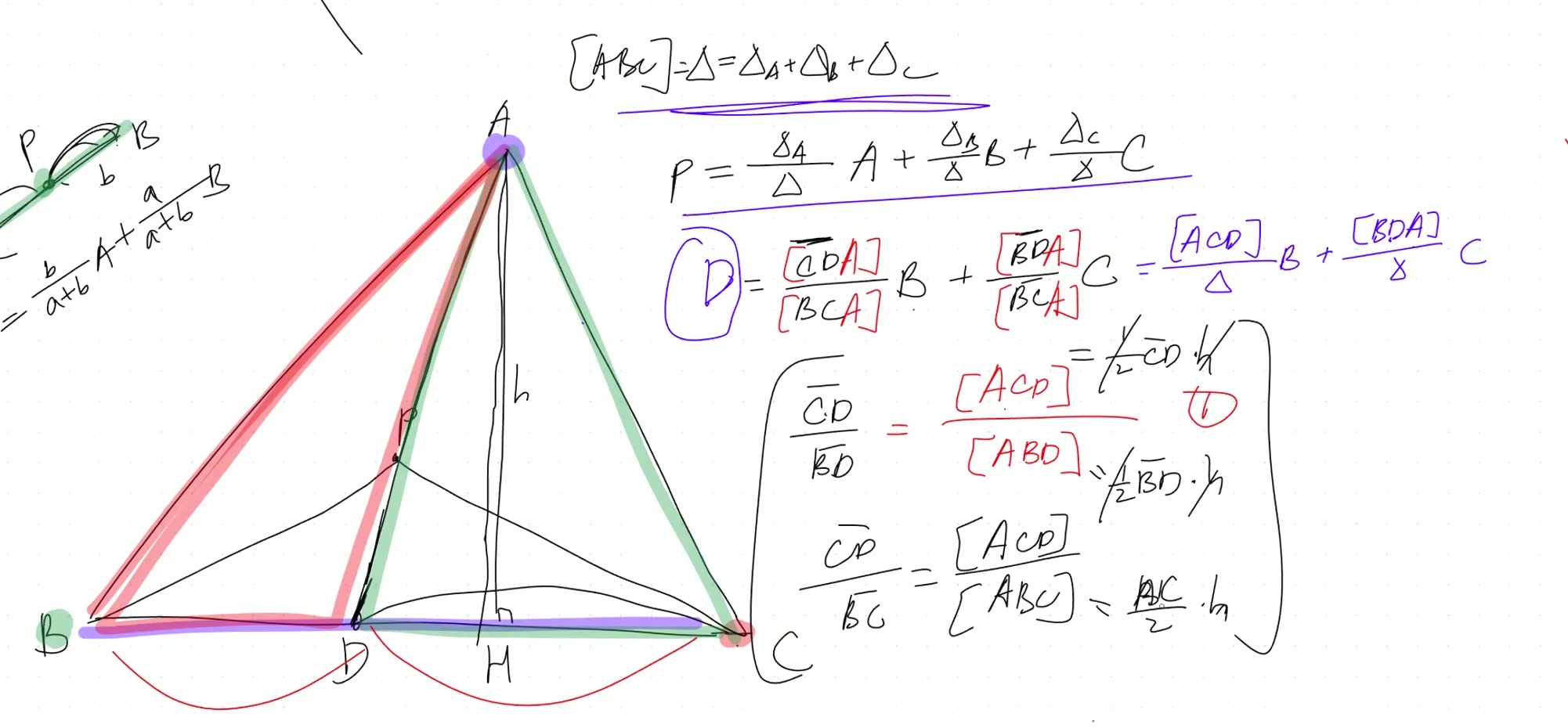
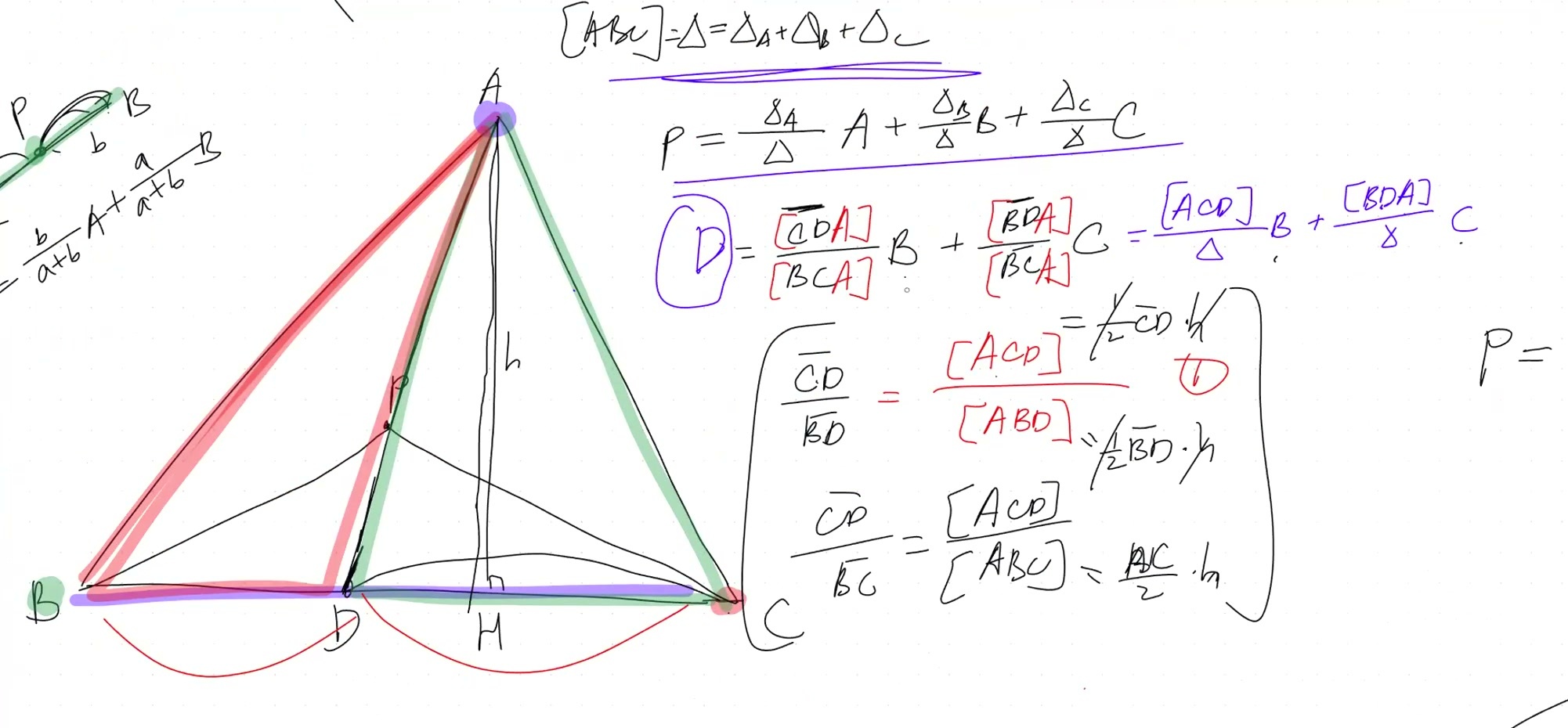
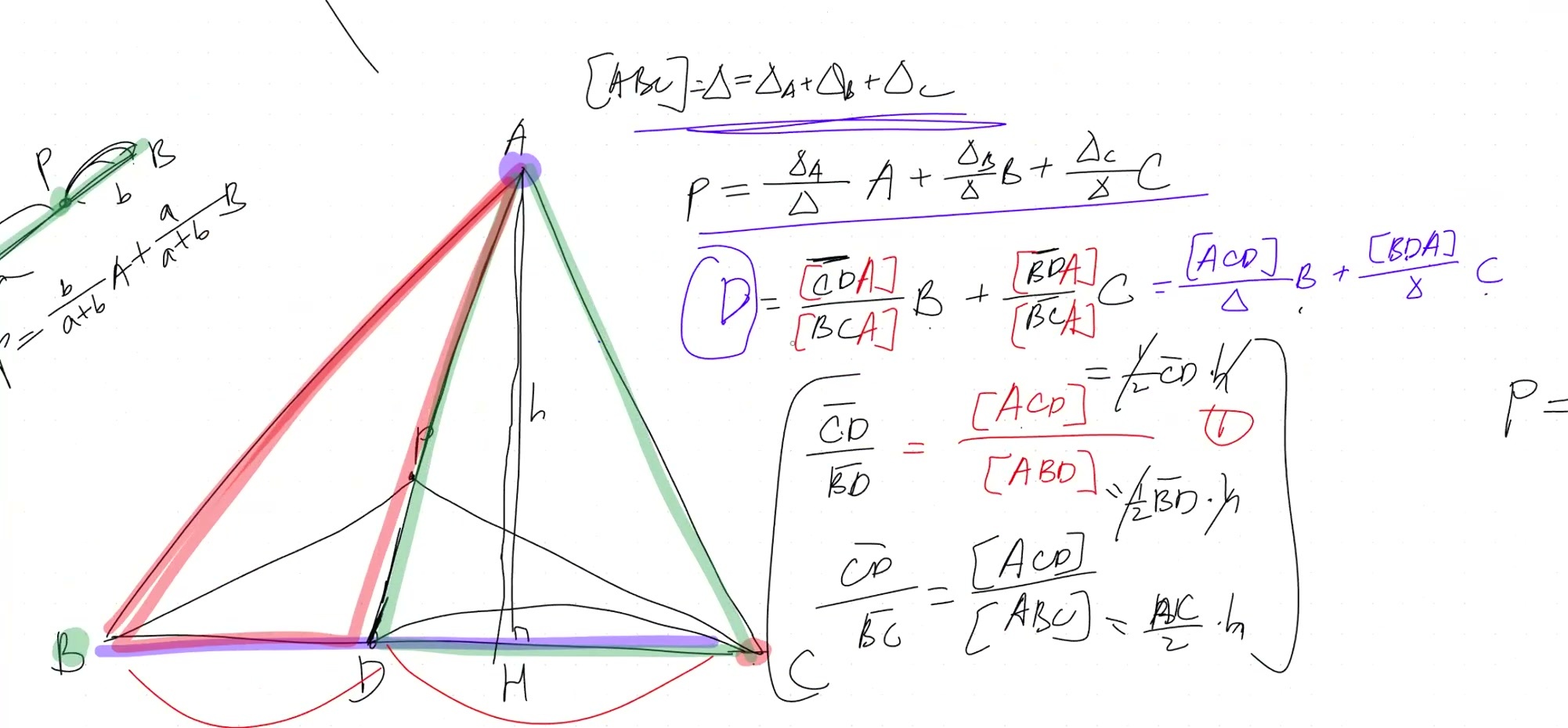
\[P = \frac{\Delta_A}{\Delta} \cdot A + \frac{\Delta_B}{\Delta} \cdot B + \frac{\Delta_C}{\Delta} \cdot C\]
On a line, the weight was related to distance (1D measurement).
In a triangle, the weight is related to area (2D measurement).
The proof uses one beautiful fact:
If two triangles share the same height, their area ratio equals their base ratio.
\[\frac{\text{Area}(\triangle ACD)}{\text{Area}(\triangle ABD)} = \frac{CD}{BD}\]
because Area = \(\frac{1}{2} \times \text{base} \times \text{height}\), and the shared height cancels out!
where:
- \(\Delta_A\) = area of triangle \(BPC\) (opposite vertex \(A\))
- \(\Delta_B\) = area of triangle \(APC\) (opposite vertex \(B\))
- \(\Delta_C\) = area of triangle \(APB\) (opposite vertex \(C\))
- \(\Delta = \Delta_A + \Delta_B + \Delta_C\) = total area of \(ABC\)
Drag point \(P\) around the triangle to see the weights change:
Three Types of Regions
The weights \(\alpha, \beta, \gamma\) (with \(\alpha + \beta + \gamma = 1\)) classify the point:
| Region | Weights | Location |
|---|---|---|
| Type 1 (interior) | All positive: \(\alpha, \beta, \gamma > 0\) | Inside triangle |
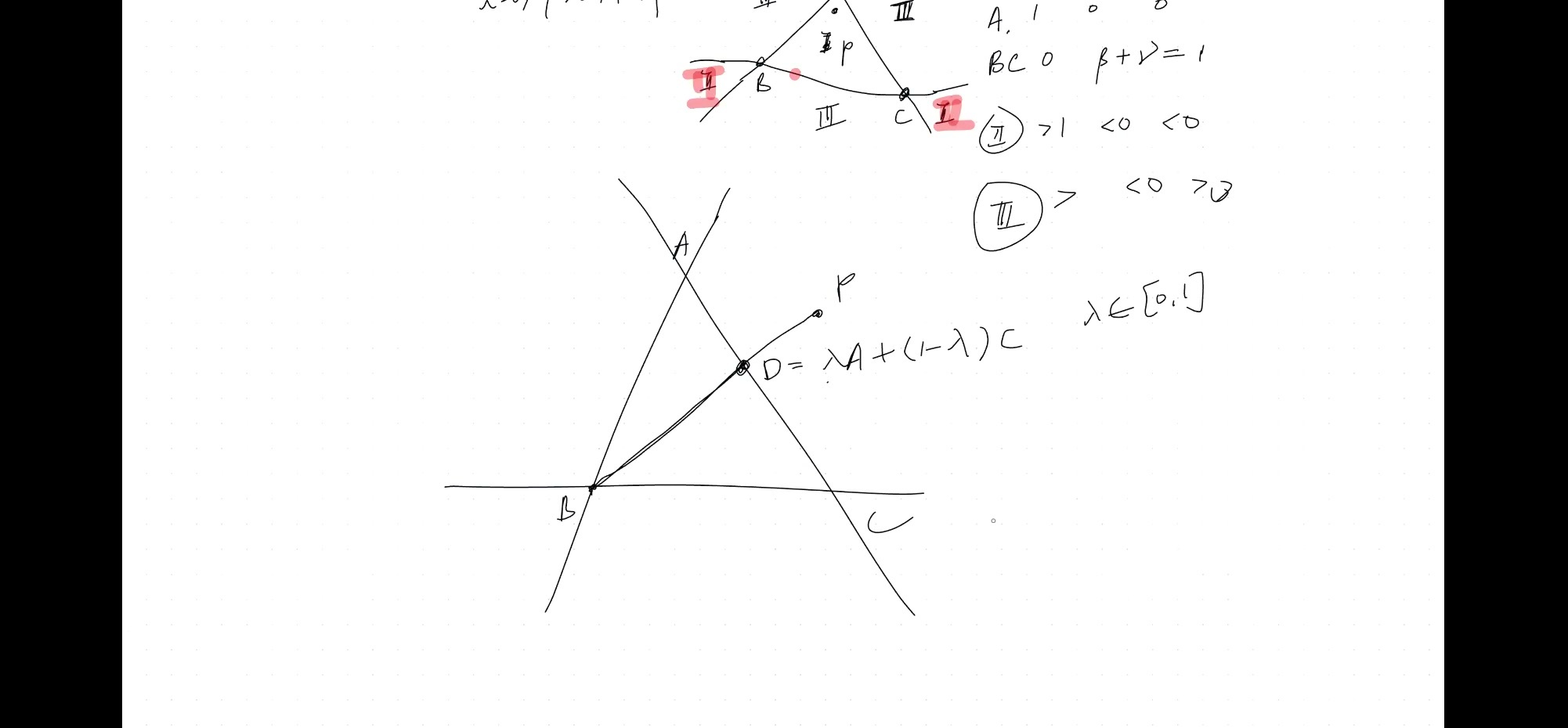
| Type 2 (near vertex) | One \(> 1\), other two \(< 0\) | Beyond one vertex |
| Type 3 (near edge) | One \(< 0\), other two \(> 0\) | Beyond one edge |
Proof: Segment Ratio = Area Ratio
If \(D\) is on segment \(BC\), then:
\[\frac{CD}{BD} = \frac{[\triangle ACD]}{[\triangle ABD]}\]
Why? Both triangles share the same altitude \(h\) from \(A\) to line \(BC\):
\[\frac{[ACD]}{[ABD]} = \frac{\frac{1}{2} \cdot CD \cdot h}{\frac{1}{2} \cdot BD \cdot h} = \frac{CD}{BD}\]
This is the key insight: same height → area ratio = base ratio
Cheat Sheet
| Concept | Formula |
|---|---|
| Point in triangle | \(P = \alpha A + \beta B + \gamma C\), weights sum to 1 |
| Weight for vertex \(A\) | \(\alpha = \frac{\text{Area}(\triangle BPC)}{\text{Area}(\triangle ABC)}\) |
| Inside triangle | All three weights positive |
| On an edge | One weight = 0 |
| At a vertex | One weight = 1, others = 0 |
| Centroid | All weights = \(\frac{1}{3}\) |
| Area ratio = base ratio | When triangles share same height |