Similar Figures, Signed Areas & Exterior Barycentric Proof
When architects build a scale model of a bridge, they know that doubling every length multiplies the area by 4 and the volume by 8. This scaling law shows up everywhere — from computing drug dosages (scaled by body surface area) to understanding why elephants have thicker legs than mice (volume grows faster than cross-section area).
Topics Covered
- Signed area of “twisted” (crossed) trapezoids
- Proving trapezoid area formula still works with negative bases
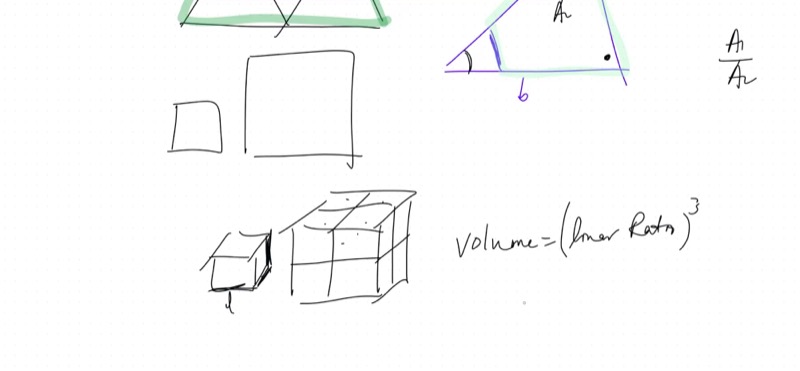
- Similar triangles: area ratio = (linear ratio)\(^2\)
- Volume scaling: volume ratio = (linear ratio)\(^3\)
- Finding geometric (unsigned) area of a crossed trapezoid
- Rigorous proof: barycentric coordinates for exterior points
- Butterfly triangle method extended to exterior points
Lecture Video
Key Video Frames
What You Need to Know First
Two triangles are similar if they have the same angles. This means all corresponding sides are in the same ratio (the linear ratio).
If \(\triangle ABC \sim \triangle DEF\) with linear ratio \(k\), then: - Every side of \(DEF\) is \(k\) times the corresponding side of \(ABC\) - \(\text{Area}(DEF) = k^2 \cdot \text{Area}(ABC)\)
Signed area assigns a direction to area. A region has positive area when traversed counterclockwise and negative area when traversed clockwise — or equivalently, when a point is on the “wrong side” of an edge. This lets formulas work universally without case-splitting for inside vs. outside.
Key Concepts
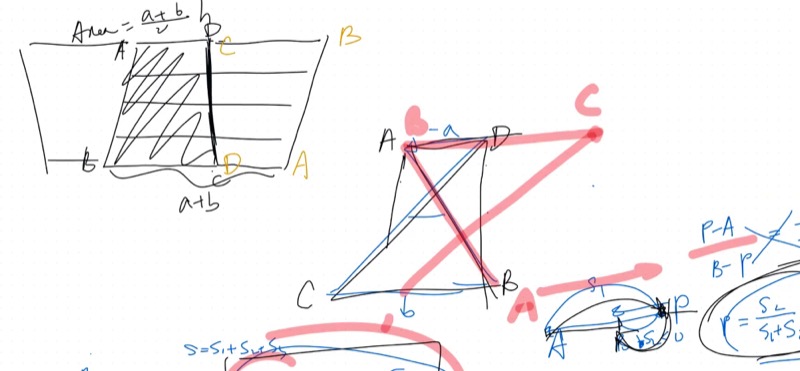
Signed Area of a Crossed Trapezoid
When you “twist” a trapezoid (cross the non-parallel sides), the upper base effectively points backward. Treating it as \(-a\) instead of \(a\):
\[\text{Signed area} = \frac{1}{2}(b - a) \cdot h\]
This gives the difference of the two triangular regions, not their sum.
| Type | Formula | What it gives |
|---|---|---|
| Signed area | \(\frac{1}{2}(b - a)h\) | \(A_2 - A_1\) (difference of triangles) |
| Unsigned area | \(\frac{1}{2} \cdot \frac{a^2 + b^2}{a + b} \cdot h\) | \(A_1 + A_2\) (sum of triangles) |
The signed version is just the standard trapezoid formula with \(a\) negative — the formula doesn’t change, only the sign of the input!
Area and Volume Scaling
For similar figures with linear ratio \(k = \frac{a}{b}\):
| Dimension | Scaling |
|---|---|
| Length | \(\times\, k\) |
| Area | \(\times\, k^2\) |
| Volume | \(\times\, k^3\) |
Example: Two similar triangles with side ratio \(1:2\).
- Area ratio: \(1:4\) (not \(1:2\)!)
- If they were 3D pyramids, volume ratio: \(1:8\)
Think of a square: double each side and you fit 4 copies of the original inside. For a cube: double each edge and you fit 8 copies inside. This works for any shape, not just squares and cubes — similarity guarantees it.
Decomposing a Crossed Trapezoid
Given a crossed trapezoid with upper base \(a\) and lower base \(b\) (\(b > a\)), the crossing creates two similar triangles:
- Upper triangle (area \(A_1\)): has base \(a\)
- Lower triangle (area \(A_2\)): has base \(b\)
- Area ratio: \(\frac{A_1}{A_2} = \frac{a^2}{b^2}\)
The heights split proportionally: \(h_1 = \frac{a}{a+b} \cdot h\), \(h_2 = \frac{b}{a+b} \cdot h\)
So: \[A_2 = \frac{1}{2} \cdot b \cdot \frac{b}{a+b} \cdot h = \frac{b^2}{2(a+b)} \cdot h\]
\[A_1 + A_2 = \frac{a^2 + b^2}{2(a+b)} \cdot h\]
Exterior Barycentric Coordinates: The Proof
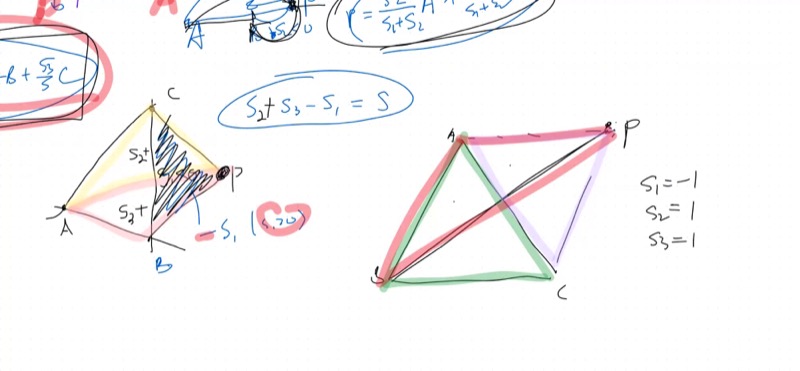
To prove \(P = \frac{S_1}{S}A + \frac{S_2}{S}B + \frac{S_3}{S}C\) when \(P\) is outside \(\triangle ABC\):
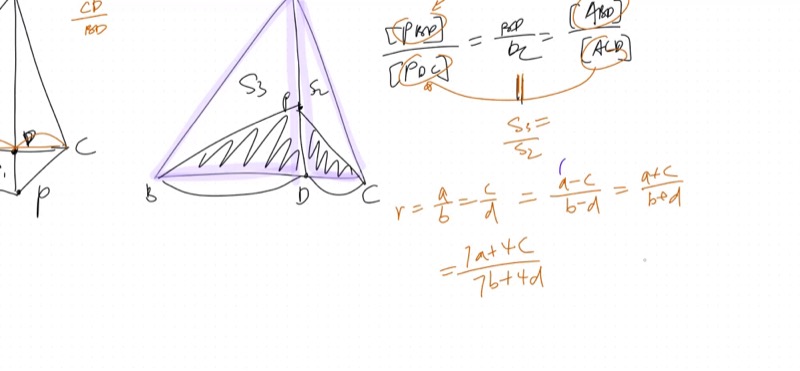
- Extend \(AP\) to meet \(BC\) at point \(D\)
- Write \(D\) as a weighted average of \(B\) and \(C\) using the ratio \(\frac{CD}{BD} = \frac{S_2}{S_3}\)
- This uses the butterfly triangle ratio: sub-triangles sharing a cevian maintain the same base ratio
- Write \(P\) as a weighted average of \(A\) and \(D\) using the ratio \(\frac{AP}{AD}\)
- Substitute the expression for \(D\) and simplify
The butterfly triangle property (equal ratios propagate) works identically for exterior points — the proof carries through unchanged.
If \(\frac{a}{b} = \frac{c}{d}\), then for any constants \(\alpha, \beta\):
\[\frac{a}{b} = \frac{c}{d} = \frac{a - c}{b - d} = \frac{a + c}{b + d} = \frac{\alpha a + \beta c}{\alpha b + \beta d}\]
Set the common ratio as \(r\), write \(a = br\) and \(c = dr\), then factor out \(r\) from any linear combination.
This is why butterfly triangle ratios work: all the sub-triangle pairs are just different linear combinations of the same base ratio.
Cheat Sheet
| What you want | What to do |
|---|---|
| Area ratio of similar figures | (Linear ratio)\(^2\) |
| Volume ratio of similar figures | (Linear ratio)\(^3\) |
| Signed trapezoid area | \(\frac{1}{2}(b - a)h\) when upper base is “negative” |
| Unsigned area of crossed trapezoid | \(\frac{a^2 + b^2}{2(a+b)} \cdot h\) |
| Exterior barycentric coords | Same formula; \(S_i < 0\) when \(P\) is on far side of edge \(i\) |
| Equal ratio propagation | \(\frac{a}{b} = \frac{c}{d} \Rightarrow \frac{\alpha a + \beta c}{\alpha b + \beta d}\) is the same ratio |
Scaling Laws
\[\text{Length} \times k, \quad \text{Area} \times k^2, \quad \text{Volume} \times k^3\]