Quadratic Equations & Graphing
Finding an equation from a graph is like being a math detective. You’re given clues (intercepts, vertices, special points) and you need to figure out the “formula” that created the pattern.
Scientists do this all the time: they collect data, plot it, and then find the equation that fits. That equation lets them predict the future — like predicting where a rocket will land or how a disease will spread.
Topics Covered
- Constructing quadratic equations from graphs
- Factored form vs completed square form
- Using x-intercepts, y-intercepts, and symmetry
- Extension to cubic polynomials
- Signs of coefficients \(a\), \(b\), \(c\)
These all mean the same thing: a value of \(x\) where \(y = 0\) (the graph touches or crosses the x-axis).
For \(y = (x-3)(x+1)\), the roots are \(x = 3\) and \(x = -1\).
Lecture Video
Key Video Frames
Two Major Forms
If \(x = r_1\), the first parenthesis becomes zero, making the whole thing zero — the point is on the x-axis!
Example: Roots at \(x = -2\) and \(x = 3\): \(y = k(x + 2)(x - 3)\) Plug in \(x = -2\): \(y = k(0)(-5) = 0\) — on the x-axis!
| Form | Expression | Best when you know… |
|---|---|---|
| Factored form | \(y = k(x - r_1)(x - r_2)\) | The roots/x-intercepts |
| Completed square | \(y = a(x - h)^2 + k\) | The vertex/AOS |
Example 1: Find equation from two x-intercepts
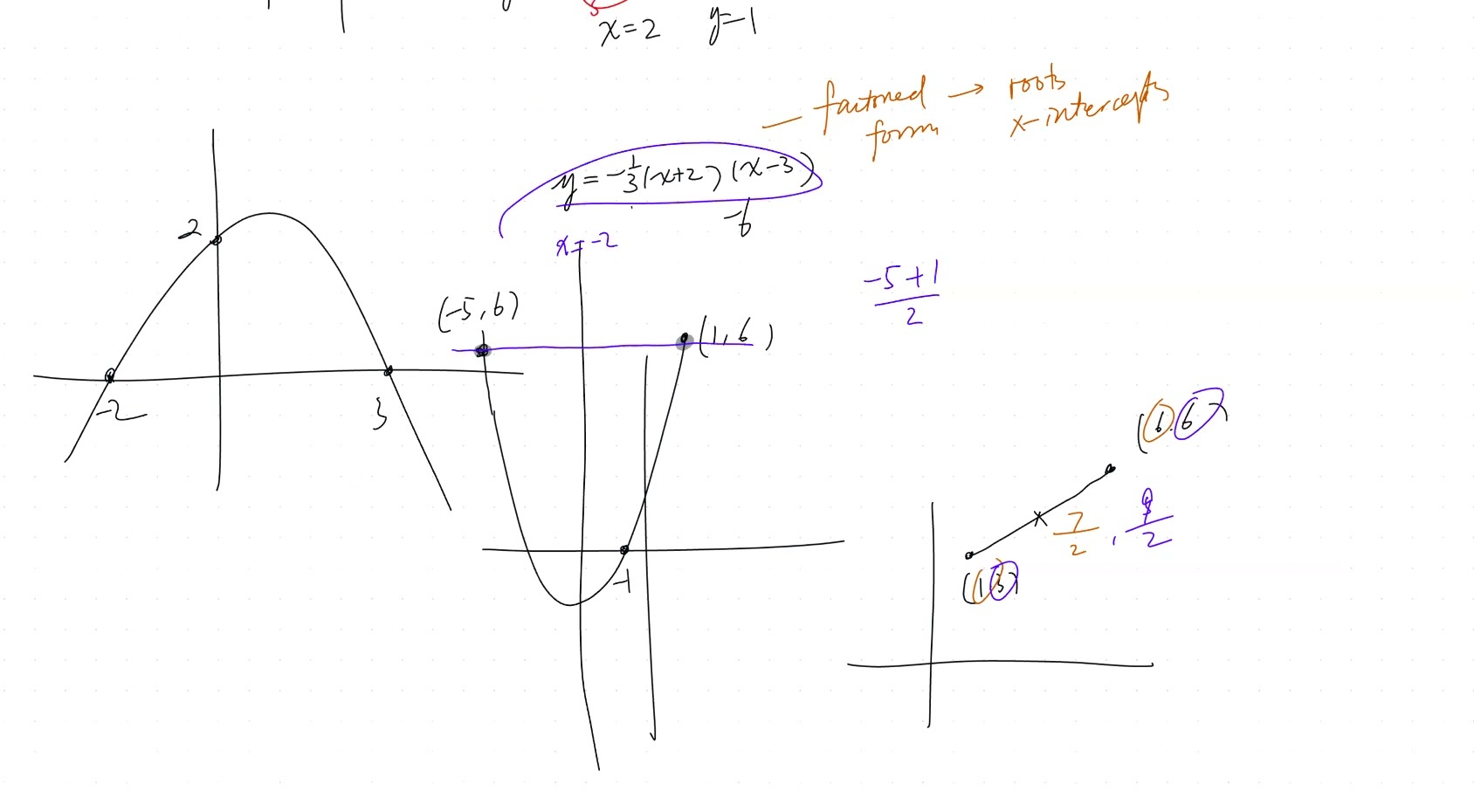
Given: x-intercepts at \(-2\) and \(3\), y-intercept at \(2\)
- From roots: \(y = k(x + 2)(x - 3)\)
- Plug in \((0, 2)\): \(2 = k(2)(-3) = -6k \Rightarrow k = -\frac{1}{3}\)
- Answer: \(y = -\frac{1}{3}(x + 2)(x - 3)\)
Try it — drag the roots and see how the parabola changes:
When two points have the same y-value, they must be mirror images across the axis of symmetry!
AOS = average of their x-values (just the midpoint formula). Think of it like a balance point — the mirror is exactly in the middle.
Example 2: Using symmetry from equal y-values
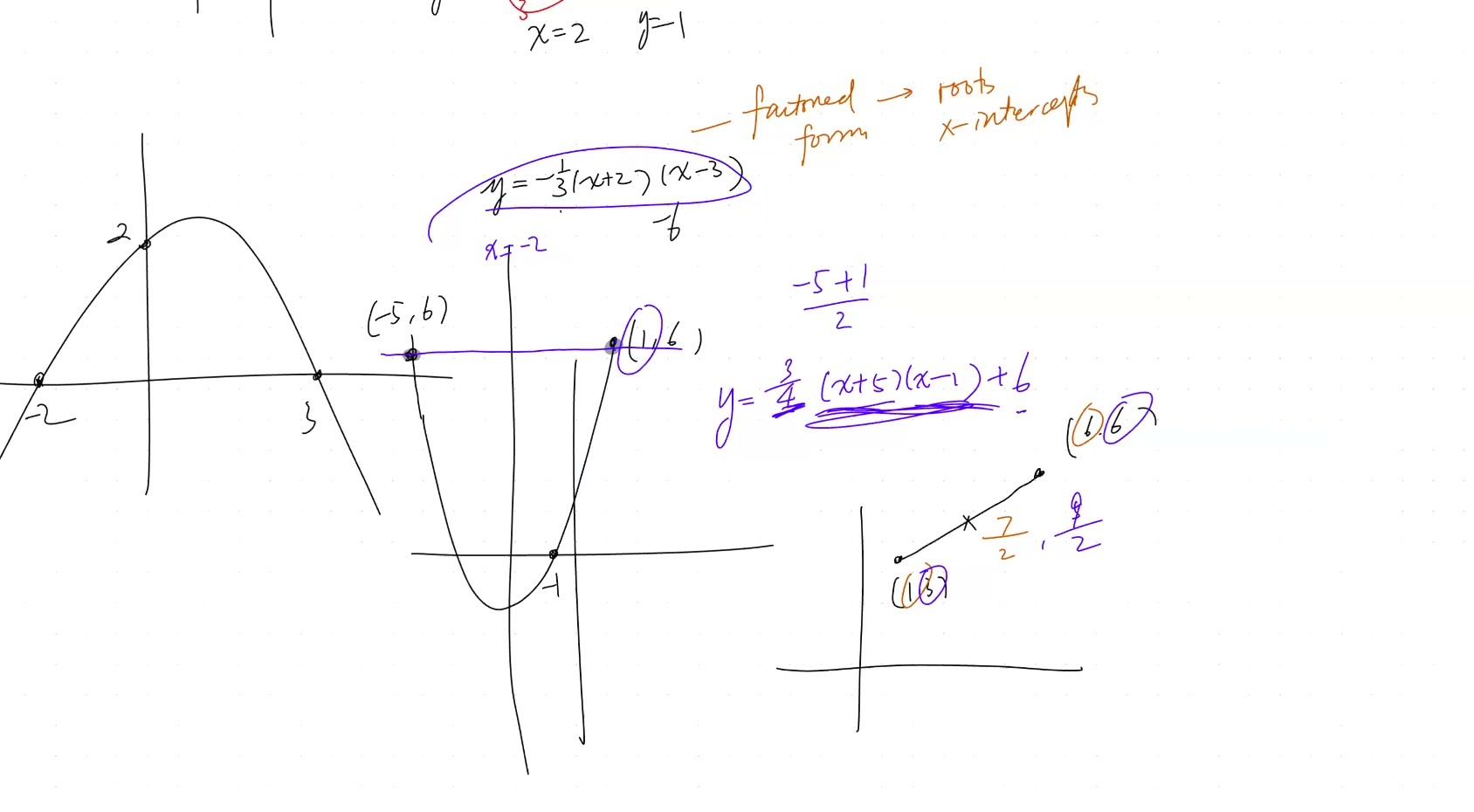
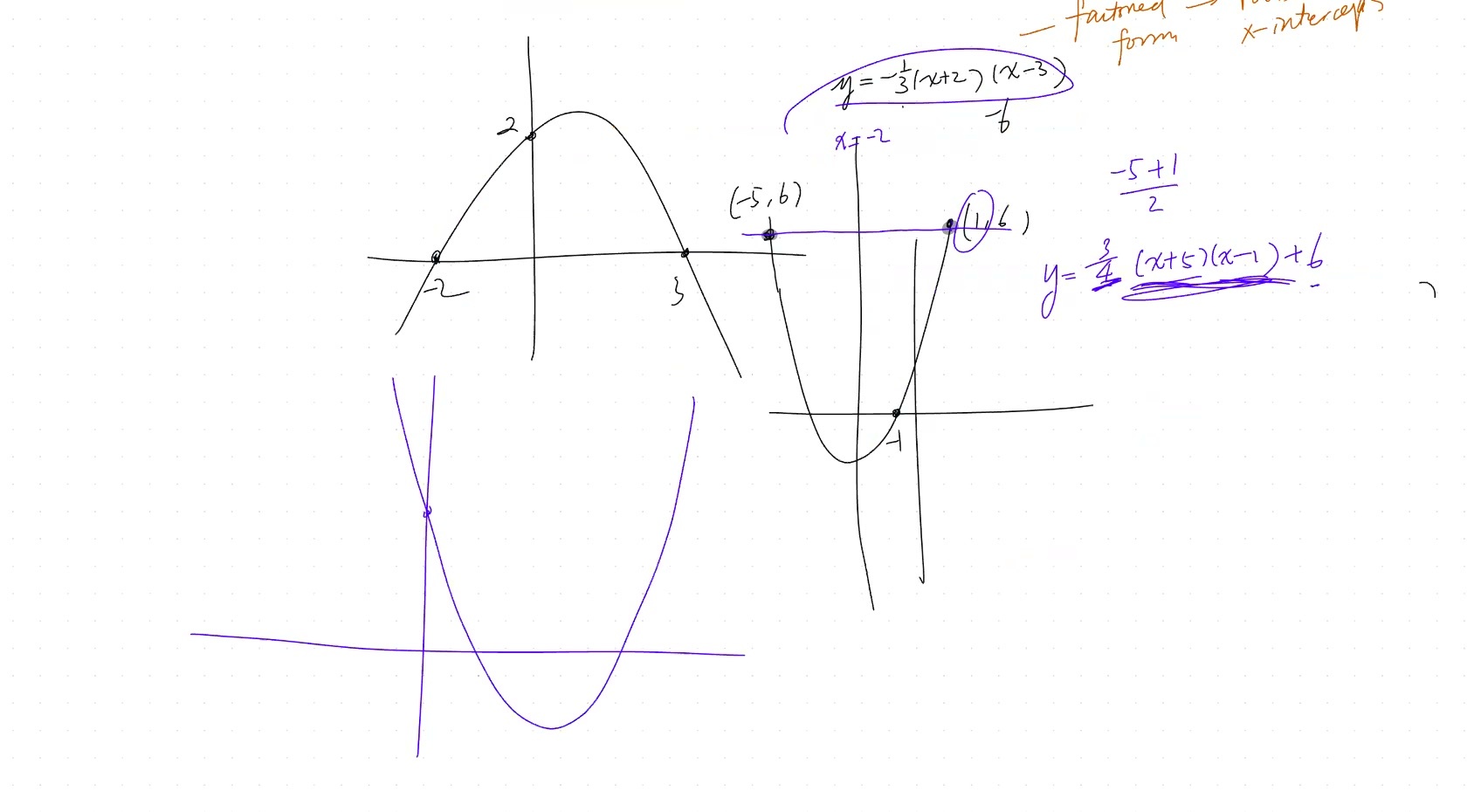
Given: Points \((1, 6)\) and \((-5, 6)\) share the same \(y\)-value, plus \((0, -1)\)
- AOS at \(x = \frac{1 + (-5)}{2} = -2\) (midpoint of symmetric points)
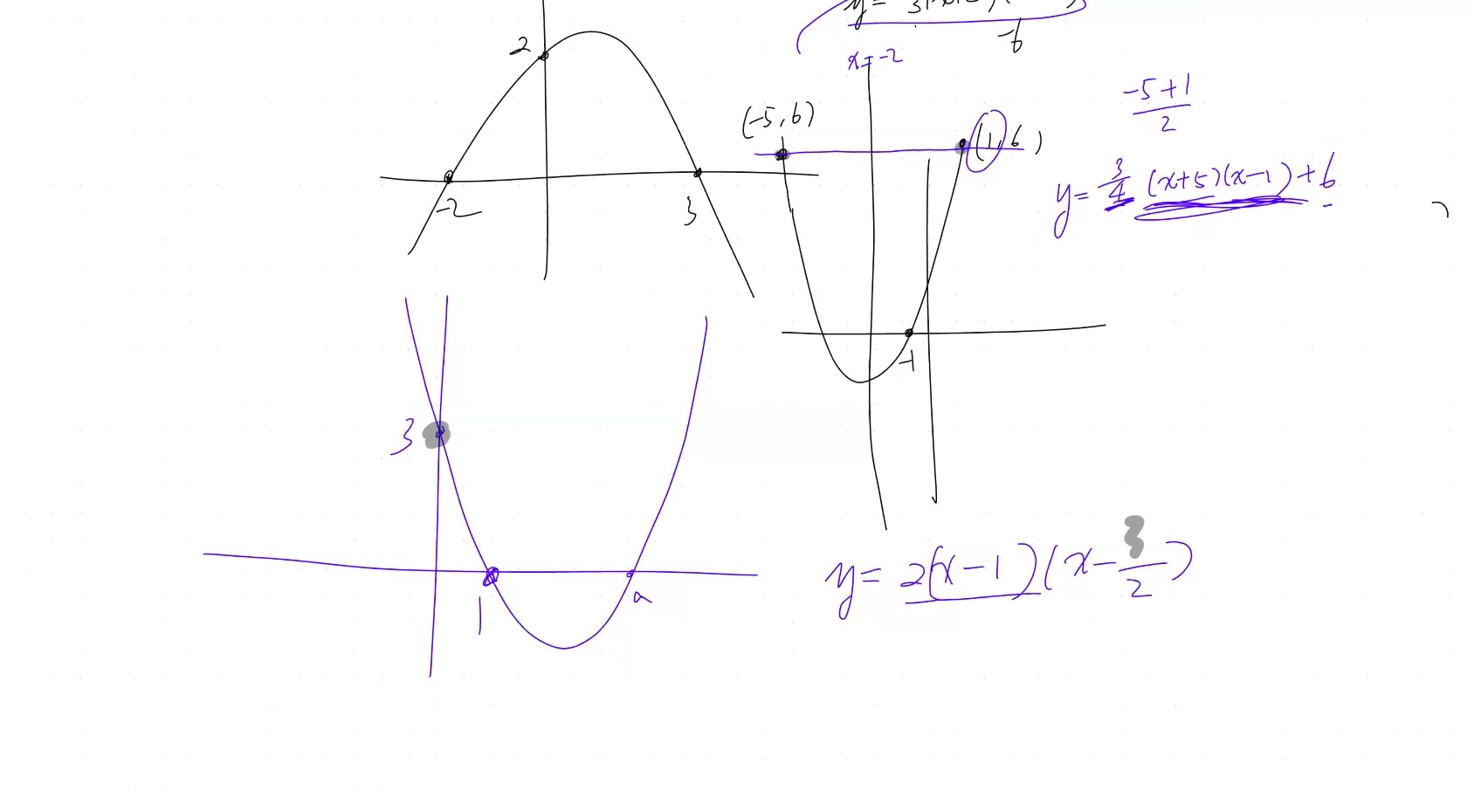
- Treat \(y = 6\) as a shifted x-axis: \(y = k(x - 1)(x + 5) + 6\)
- Plug in \((0, -1)\): \(-1 = k(0-1)(0+5) + 6 \Rightarrow k = \frac{7}{5}\)
Key insight: Points with equal y-values reveal the axis of symmetry!
| Feature | Quadratic (\(x^2\)) | Cubic (\(x^3\)) |
|---|---|---|
| Highest power | 2 | 3 |
| Shape | U or upside-down U | S-curve |
| Max roots | 2 | 3 |
| End behavior | Same direction both sides | Opposite directions |
| Max turning points | 1 | 2 |
The key insight: odd powers go in opposite directions at the extremes, even powers go in the same direction.
Example 3: Extension to cubic polynomials
Given: Roots at \(-6\), \(-2\), \(4\); y-intercept at \(-4\)
- From roots: \(y = k(x + 6)(x + 2)(x - 4)\)
- Plug in \((0, -4)\): \(-4 = k(6)(2)(-4) = -48k \Rightarrow k = \frac{1}{12}\)
Determining signs of \(a\), \(b\), \(c\)
Given a graph of \(y = ax^2 + bx + c\):
- \(c\) = y-intercept (positive if graph crosses y-axis above origin)
- \(a\) = opens up (\(a > 0\)) or down (\(a < 0\))
- \(b\): use AOS formula \(x = -\frac{b}{2a}\)
- If AOS is positive and \(a < 0\): then \(b > 0\) (two negatives cancel)
Cheat Sheet
How to find an equation from a graph:
- Know the roots? → Use factored form \(y = k(x - r_1)(x - r_2)\)
- Know the vertex? → Use vertex form \(y = a(x - h)^2 + k\)
- Two points with same y? → Their midpoint = axis of symmetry
- Always: use one extra point to solve for the unknown coefficient \(k\)
| Concept | Formula |
|---|---|
| Factored form | \(y = k(x - r_1)(x - r_2)\) |
| Midpoint (symmetry) | \(x_{AOS} = \frac{x_1 + x_2}{2}\) |
| AOS from coefficients | \(x = -\frac{b}{2a}\) |
| Cubic factored form | \(y = k(x - r_1)(x - r_2)(x - r_3)\) |