Polynomial Graphing & Transformations
This kind of skill — matching patterns to models — is exactly what machine learning does! When Netflix recommends a movie or Spotify suggests a song, algorithms are matching patterns in data to known models, just like we’re matching graphs to equations.
Topics Covered
- Matching polynomial equations to their graphs
- Even vs odd power: end behavior
- Maximum turning points = degree \(- 1\)
- Polynomial long division
- The discriminant: \(\Delta = b^2 - 4ac\)
- Double roots, triple roots, and graph behavior
The Detective’s Toolkit
When you see a polynomial graph, ask these questions in order:
- What happens at the ends? (Both up? Both down? Opposite?) — This tells you even/odd degree and the sign of the leading coefficient.
- How many times does it turn? — This bounds the degree (turns \(\leq\) degree \(- 1\)).
- Where does it cross or touch the x-axis? — These are your roots. Does it cross (odd multiplicity) or bounce (even multiplicity)?
- Where does it cross the y-axis? — That’s the constant term (plug in \(x = 0\)).
Lecture Video
Key Video Frames

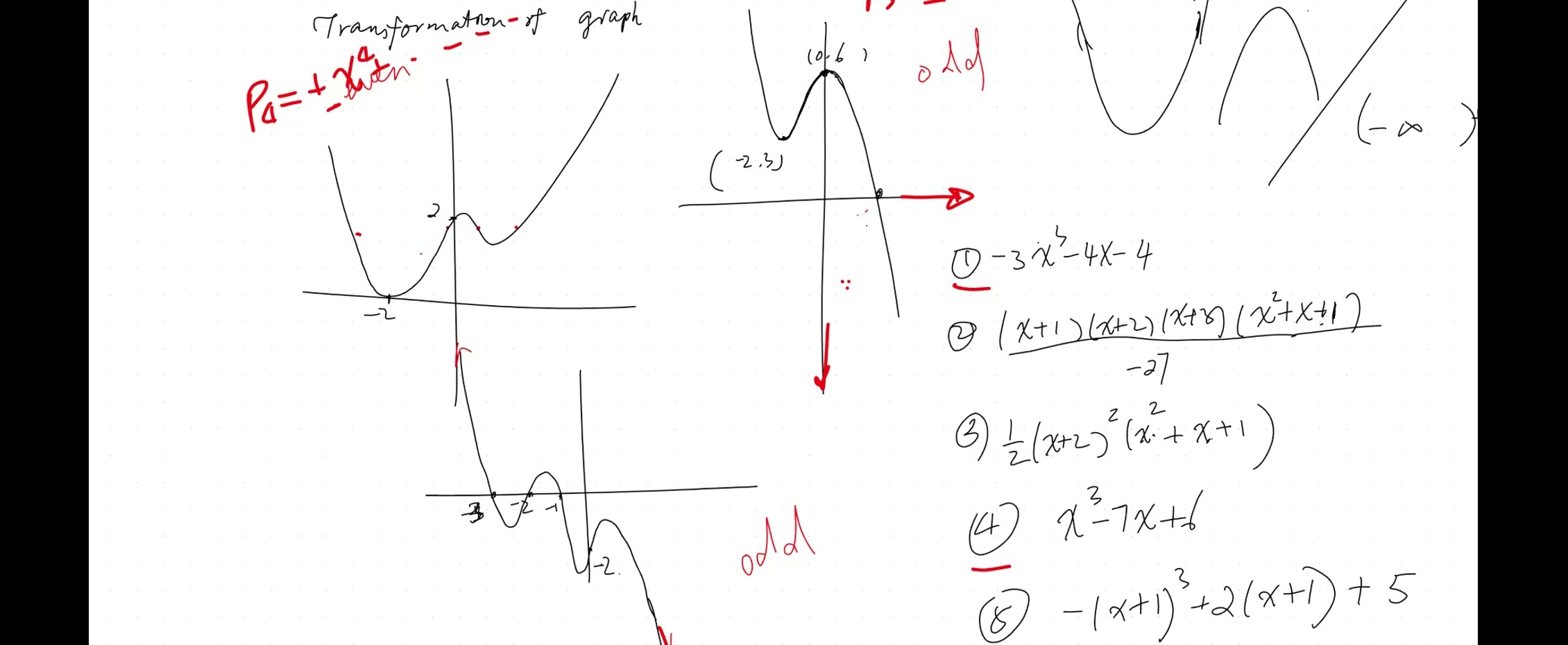
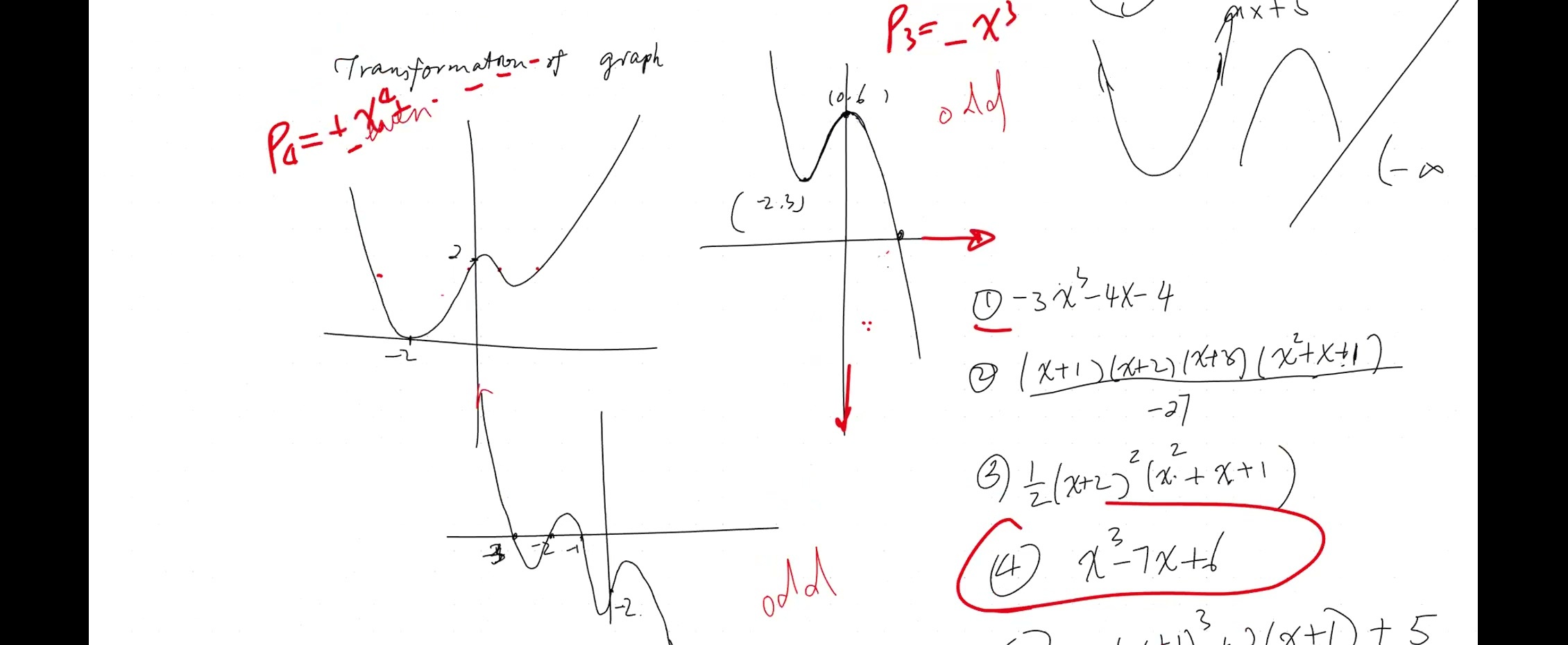
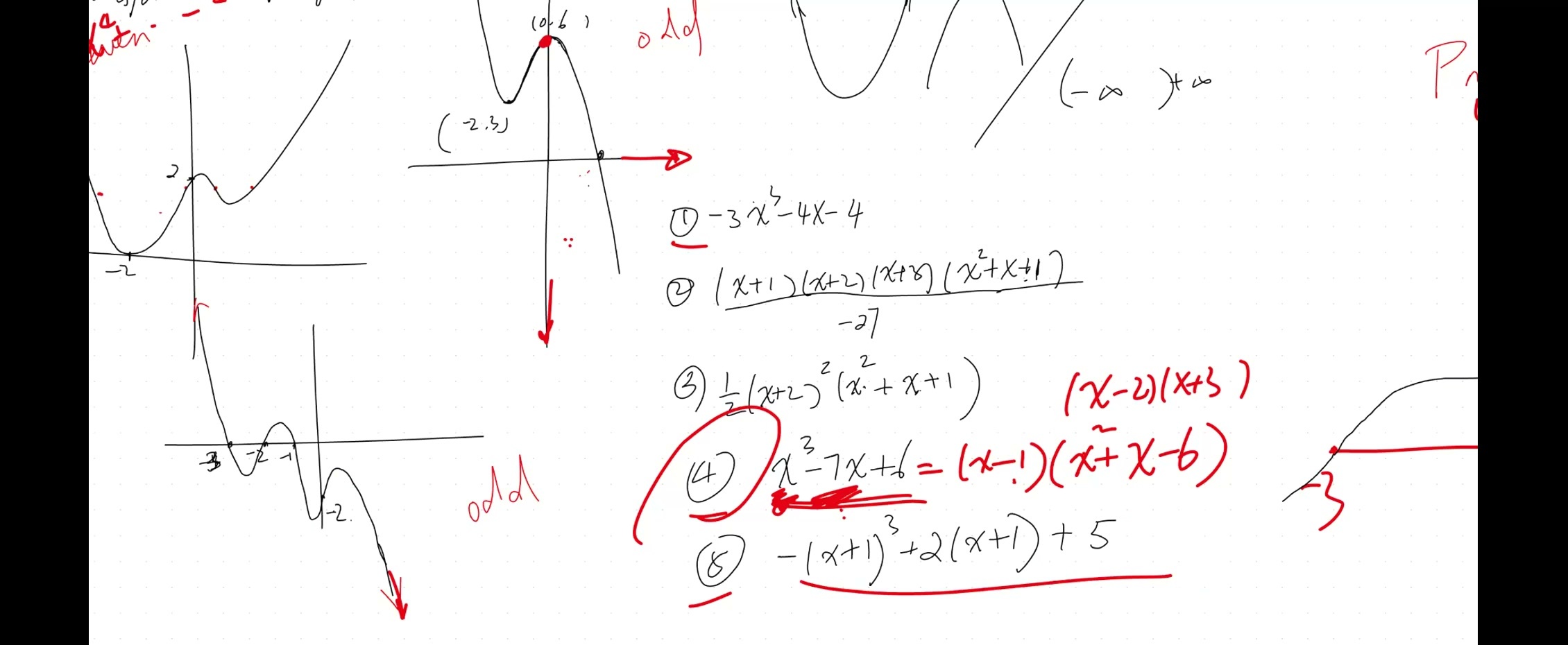
End Behavior
| Leading term | \(x \to +\infty\) | \(x \to -\infty\) |
|---|---|---|
| \(+x^{\text{even}}\) | \(+\infty\) | \(+\infty\) |
| \(-x^{\text{even}}\) | \(-\infty\) | \(-\infty\) |
| \(+x^{\text{odd}}\) | \(+\infty\) | \(-\infty\) |
| \(-x^{\text{odd}}\) | \(-\infty\) | \(+\infty\) |
Just check what happens when \(x \to +\infty\) (far right of graph):
- If the graph goes UP on the right → positive leading coefficient
- If the graph goes DOWN on the right → negative leading coefficient
That’s it! One glance at the right side tells you the sign.
Maximum turning points = \(n - 1\) for degree \(n\) polynomial
A polynomial of degree \(n\) has at most \(n - 1\) turning points.
| Degree | Max turns | Like… |
|---|---|---|
| 1 (linear) | 0 | A straight line — no turns |
| 2 (quadratic) | 1 | A U-shape — turns once |
| 3 (cubic) | 2 | An S-shape — turns twice |
| 4 (quartic) | 3 | A W-shape — turns three times |
Key word: AT MOST. A cubic can have 0 turns (like \(y = x^3\)) but never more than 2.
Example 1: Factor \(x^3 - 7x + 6\)
Just like regular long division, but with \(x\)’s!
If we know one root (say \(x = 1\)), we can divide by \((x - 1)\) to find the remaining factors. Match the highest power first, subtract, bring down, repeat.
- Try \(x = 1\): \(1 - 7 + 6 = 0\) ✓ → \((x - 1)\) is a factor
- Polynomial division: \(x^3 - 7x + 6 = (x - 1)(x^2 + x - 6)\)
- Factor quadratic: \((x^2 + x - 6) = (x - 2)(x + 3)\)
- Result: \((x - 1)(x - 2)(x + 3)\), roots at \(x = 1, 2, -3\)
Explore — change the roots and leading coefficient:
For \(ax^2 + bx + c = 0\), the discriminant \(\Delta = b^2 - 4ac\) tells you how many roots the quadratic has. Think of it as a “reality check” — it tells you whether the parabola actually reaches the x-axis or floats above/below it.
The Discriminant
For \(ax^2 + bx + c = 0\):
\[\Delta = b^2 - 4ac\]
| \(\Delta\) | Roots |
|---|---|
| \(\Delta > 0\) | Two distinct real roots |
| \(\Delta = 0\) | One repeated (double) root |
| \(\Delta < 0\) | No real roots (complex) |
“This is the most important knowledge point concerning quadratic equations!”
- Single root \((x-r)^1\): the factor changes sign as \(x\) crosses \(r\), so the graph crosses
- Double root \((x-r)^2\): the factor is always non-negative (a square!), so the graph bounces
- Triple root \((x-r)^3\): odd power, so it crosses — but the flat slope creates an S-shape
The rule: odd powers cross, even powers bounce.
Root Behavior at x-axis
- Single root \((x - r)^1\): graph crosses x-axis
- Double root \((x - r)^2\): graph touches and bounces back
- Triple root \((x - r)^3\): graph crosses with a flat inflection
See all three behaviors — single root at \(a\), double root at \(b\), triple root at \(c\):
Cheat Sheet
| Step | What to check |
|---|---|
| 1 | Even or odd degree? (same ends = even, opposite = odd) |
| 2 | Positive or negative leading coefficient? (right side up or down?) |
| 3 | How many turning points? (max = degree - 1) |
| 4 | What’s the y-intercept? (plug in \(x = 0\)) |
| 5 | Can you find easy roots? (try \(x = 0, \pm 1, \pm 2\)…) |
| 6 | Single, double, or triple roots? (cross, bounce, or flat) |